STEM Activities for Preschoolers: Easy Science Games

TL;DR for Busy Parents
- STEM activities for preschoolers don't need a kit, a lab coat or a Pinterest-worthy tray. Ice, water, seeds and cardboard will do.
- Early childhood experts say good early STEM looks a lot like play — children moving, doing, testing and discovering, not filling in worksheets.
- Aim for a short, focused burst — no need for a lesson plan — plus one question and a lot of "What do you think will happen?"
- Four easy categories to rotate: physical science, life science, earth and space, and engineering.
- The goal isn't a correct answer. It's a child who believes "I'm someone who figures things out."
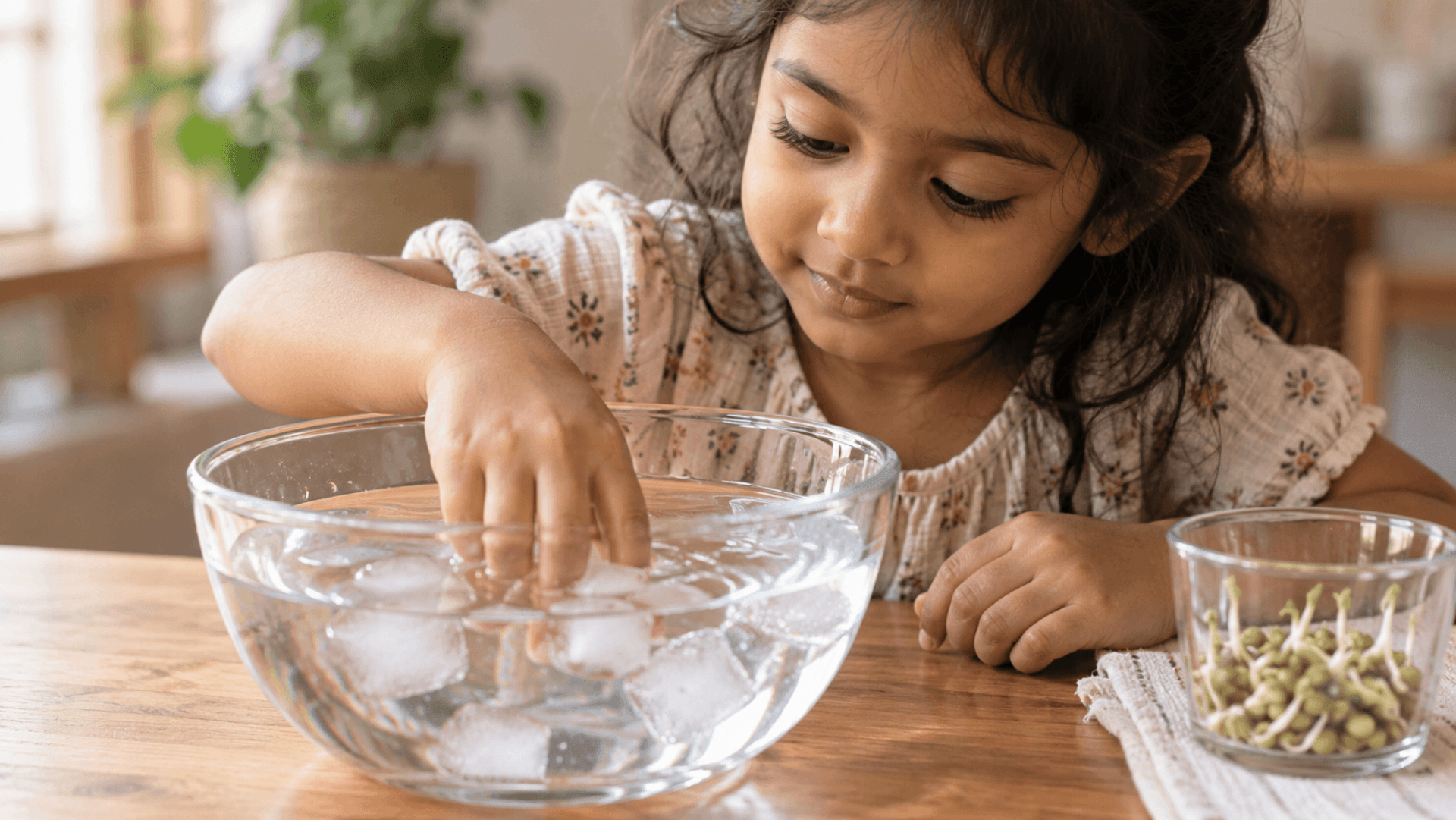
It usually starts at the dining table. You hand over a glass of water, and within ninety seconds your five-year-old is blowing bubbles through a straw, dropping in a raisin to see if it floats, and asking why the ice is "sweating".
And your first instinct, completely understandable, especially before 8am, is "Aiyo, drink properly lah."
Here's the slightly annoying truth: that mess is science. Your child is running an experiment. They're testing, observing and forming theories, which is more or less what scientists do, just with fewer spills and better supervision.
The good news is that meaningful STEM activities for preschoolers are far simpler than the internet makes them look. You don't need a subscription box or a laminated chart. You need water, a few minutes, and a willingness to say "Let's find out."
Why STEM Activities for Preschoolers Matter (Before Formal School)
There's a tempting idea that science can wait until Standard One, when children can read instructions and hold a pencil properly. But the research points the other way.
ZERO TO THREE describes preschool as a critical early education environment for developing a positive STEM identity. Early, age-appropriate and joyful STEM activities make it more likely that children enter kindergarten with both a strong foundation in STEM skills and a positive STEM identity.
Translation: what you're building at four isn't knowledge of physics. It's the feeling of "I'm good at figuring things out." That feeling walks into the classroom with them.
There's also evidence that structured, play-based STEM makes a measurable difference. In an evaluation of a free preschool STEM curriculum, three-year-olds in the treatment group showed significant differences in maths skills. Students in public 3K/4K treatment sites scored significantly higher in maths than those in control sites.
So no, hands-on science isn't just cute enrichment. It's foundational.
The single biggest mistake: turning it into schoolwork
If you take one thing from this article, take this. Experts are clear that maths instruction for young children is not a paper-and-pencil experience. Best practice in early STEM looks a lot like play and exploration, with children moving, doing, testing and discovering.
That means the pouring, the stacking, the knocking-over-and-rebuilding is the lesson. You do not need to add a worksheet at the end to make it count.
The Four Types of Hands-On Science Your Child Is Ready For
ZERO TO THREE groups age-appropriate early science and engineering into four friendly categories: physical sciences (such as exploring ice melting), life sciences (such as planting seeds and observing growth), earth and space science (such as learning about weather and how it impacts humans and animals), and engineering design. Engineering design essentially means using maths and science to solve a problem, like building a noisemaker to "wake" a sleeping puppet.
Rotate through these four and you've covered a surprisingly complete preschool science syllabus using things in your kitchen.
Let's take them one at a time.
1. Physical Science: The Great Ice Investigation
Malaysian weather is basically a free physics lab. Ice melts here with real enthusiasm.
The set-up: Give your child three ice cubes in three bowls. One goes on the kitchen table, one on the balcony or porch in the sun, one in the fridge. Ask one question before you start: "Which one will disappear first?"
Then let them check every few minutes. Five-year-olds love a job with a clipboard energy to it, even without a clipboard.
Variations for when they want more:
- Freeze a small toy inside an ice cube and let them "rescue" it. With you close by, offer lukewarm (not hot) water, salt and a spoon, and let them choose the tool.
- Freeze water with a few drops of food colouring and melt it over a white plate.
- Ask them to predict: will a big cube or a small cube melt first? Then test it.
What you say matters more than what you buy. Try "What did you notice?" instead of "What's the answer?" There is no failing grade in a bowl of water.
2. Life Science: Seeds, Sprouts and Patience
Planting seeds and observing growth is one of the clearest life-science activities for this age — and it teaches something rarer than science: waiting.
The easiest version: wet cotton wool in a clear plastic cup, a few green bean seeds (any wet market or supermarket packet works), placed on a windowsill. Your child waters lightly and checks daily.
Make it stick:
- Draw a picture each day in a small notebook. Three-year-olds will scribble; five-year-olds will start adding roots. Both are observation.
- Plant two cups: one gets water, one doesn't. Let them discover why one is sad-looking. (Yes, it feels cruel. It's also unforgettable.)
- Try pandan cuttings, kangkung stems in water, or the top of a carrot. Local, cheap, and it grows.
If your child gets attached and names the sprout, congratulations — you now have a family pet with very low maintenance costs.
3. Earth and Space: Become Weather People
Earth and space science for young children includes learning about weather and how it impacts humans and animals — and living in Malaysia, you have material every single afternoon.
Daily weather chart: A piece of paper with seven boxes. Each morning, your child looks outside and draws sun, cloud or rain. By the end of a week, they've made a data set without knowing the phrase.
Questions that go further:
- "Where do the birds go when it rains?"
- "Why do we bring in the laundry so fast?"
- "What does the cat do when it's very hot?"
The puddle project: After a downpour, mark the edge of a puddle with a stick or a chalk line. Check it after lunch. Where did the water go? This is evaporation, and your child just watched it happen without anyone using the word.
4. Engineering Design: Build Something That Does a Job
This is where STEM activities for kindergarten kids get genuinely fun, because engineering design is simply using maths and science to solve a problem — like building a noisemaker to "wake" a sleeping puppet.
That example is gold, by the way. Borrow it directly.
Tonight's challenge, in three steps:
- Put a soft toy "to sleep" on the sofa. Announce that Teddy must be woken up, but nobody is allowed to touch him.
- Offer a box of junk: empty plastic tubs or containers, rubber bands, an old container, a wooden spoon. If you include dried rice or beans, keep them in a sealed bag and stay close by, as loose small pieces are a choking hazard for little ones.
- Let them build a noisemaker. Then test it on poor Teddy.
More engineering challenges that need nothing special:
- The bridge: two stacks of books, one sheet of A4 paper. Can it hold a toy car? What if you fold the paper into a concertina first?
- The tallest tower: using only paper cups, or only blocks, or only rolled newspaper. Time limit: five minutes. Falling down is part of it.
- The rain shelter: build a roof for a small toy using cardboard and tape, then test it under a gently dripping tap.
- The ramp: a plank or a tray propped on cushions. Which toy car goes furthest? What happens if you make it steeper?
Notice that every one of these has a problem at the centre. That's the difference between an activity and an engineering challenge, and it's what makes children persist when the first version collapses.
How to Run a 15-Minute Science Game Without Losing Your Mind
You don't need a whole afternoon. You need a rhythm.
- Ask one question first. "What do you think will happen if…?" Write or draw their guess. Guessing wrong is the best part.
- Let them do the doing. Your hands stay off unless there's a safety issue. Clumsy pouring is motor skills plus volume, two lessons at once.
- Narrate what you see, not what's correct. "The big cube is still there and the small one is gone." They'll draw the conclusion.
- Stop while they still want more. Ten good minutes beats forty minutes of you begging them to finish.
- Set up for mess. Old towel, tray, outside the kitchen door. Mess-anxiety is the number one killer of hands-on science experiments at home.
What if my child asks a question I can't answer?
Say so. "I don't know — let's find out together" is one of the most valuable sentences a child can hear from you. It models exactly what you want: curiosity without embarrassment.
Common Parent Questions About STEM Games for Kindergarten Kids
"Is my three-year-old too young?" No. The research on early STEM specifically includes toddlers and preschoolers. There's even a free downloadable curriculum built for children aged 30 to 48 months, with 22 play-based maths activities, 22 play-based science and engineering activities, and 44 specially-composed songs. Songs, by the way, are a very good hint about the intended energy level.
"Do I need to buy STEAM kits?" Not at all. STEAM activities for preschoolers just add art to the mix: colour mixing, drawing what they observed, building and decorating a model. Your existing crayons already qualify.
"My child loses interest after two minutes." That's normal, and it's often a sign the activity is too adult-led. Hand over more control: let them choose which object to test, or which tool to use. Ownership buys attention.
"Should we do this every day?" A couple of times a week is usually plenty; little and often beats a big production. School holidays are a good time to go bigger, with a seed that grows over a fortnight, or a week of weather charts.
"What about screens?" Screens aren't the enemy of hands-on science, but they shouldn't replace it. If your child uses a learning app, look for calm, slow-paced ones that spark questions rather than overstimulate. StoryTime is built to be low-stimulation for ages 3-7, which makes it a reasonable wind-down after a very wet afternoon of ice experiments. Then go back to the real bowl of water.
A Gentle Note on Development
Children arrive at these skills at wildly different times. One five-year-old will count the seeds carefully; another will squash them. Both are fine.
If you have ongoing concerns about your child's development, attention or learning — the kind that don't shift over months — speak to your paediatrician or a child development specialist. An article can't assess your child; a professional can.
The Bottom Line
You already do more STEM than you think. Every time you let your child stir, pour, stack, dig or ask "why", you're doing the work.
The shift isn't adding a new activity to your already-full week. It's noticing the ones happening anyway, slowing down for ten minutes, and asking one good question instead of tidying it all away.
So tomorrow, when the ice cube starts sweating on the table again — pause. Ask what they think will happen. Then let them find out.
That's it. That's the whole programme.